

Top Companies Leading the Qubits Revolution in 2026. Quantum computing is one of the most transformative technologies of the current era, and its foundation lies in qubits — quantum bits that leverage superposition and entanglement to perform computations far beyond the capabilities of traditional bits.
As qubit technology improves — with better coherence, lower error rates, and more efficient error correction — progress toward practical, large‑scale quantum computers accelerates. In 2026, a mix of established tech giants and innovative startups are leading this quantum revolution, each pushing the boundaries of hardware, software, and real‑world applications.
This article explores the top companies shaping the qubits landscape today — from those building cutting‑edge quantum processors to platforms enabling broader access and hybrid quantum/cloud solutions.
We’ll explain what each company does, why it matters, and how it contributes to the quantum future.
1. IBM Quantum: The Pioneer With a Clear Roadmap
IBM is widely regarded as one of the most influential leaders in quantum computing. With decades of research and a long‑term vision, IBM has consistently pushed the envelope from early experimental systems to today’s emerging utility‑scale devices.
IBM’s quantum strategy includes:
- Hardware development: IBM continues to roll out increasingly powerful quantum processors. For instance, its latest Heron processors optimized for performance and reduced error rates are available through the modular IBM Quantum System Two platform.
- Cloud access: Through the IBM Quantum Experience and Qiskit open‑source framework, developers and researchers worldwide can access real quantum hardware and build quantum applications.
- Fault‑tolerant roadmap: IBM’s roadmap extends toward fault‑tolerant systems by the end of the decade, targeting logical qubit machines that can correct errors reliably.
IBM’s leadership spans hardware, software, and ecosystem building — making it a cornerstone of quantum advancement.
2. Google Quantum AI: Innovation From the Big Tech Frontier
Google’s quantum research group — Google Quantum AI — has drawn international attention since its groundbreaking 2019 demonstration of quantum supremacy with the Sycamore processor.
Today, the company focuses on:
- Advanced quantum chips: Google’s “Willow” chip represents a leap in error reduction and performance, completing complex benchmark computations in minutes that would take classical computers eons.
- Error‑correction research: Like its peers, Google is tackling quantum error correction — a major barrier to practical systems.
- Integration with AI: Because Google is also a leader in artificial intelligence, there’s significant interest in hybrid quantum‑AI workflows, where quantum processors accelerate specific tasks in machine learning and optimization.
As a research‑heavy initiative backed by Alphabet’s resources, Google Quantum AI remains both a leader in fundamental science and a potential driver of future commercial applications.
3. IonQ: Trapped‑Ion Specialists With Commercial Momentum
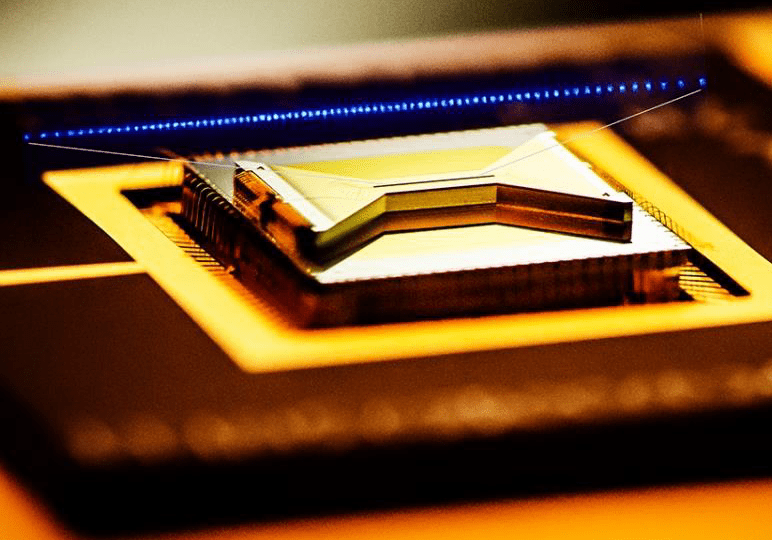
One of the most prominent specialist quantum firms is IonQ, a company exclusively focused on trapped‑ion qubit technology — a hardware approach known for long qubit lifetimes and high‑fidelity operations.
What sets IonQ apart:
- Trapped‑ion precision: IonQ’s systems use ions trapped in electromagnetic fields and manipulated with lasers, providing highly accurate qubit control.
- Cloud availability: Through partnerships with AWS, Azure, and Google Cloud, IonQ’s systems are accessible to a broad audience of researchers and businesses.
- M&A expansion: IonQ’s recent acquisitions — including quantum networking and photonic interconnect companies — reflect its strategy to expand beyond hardware into broader quantum technologies.
IonQ’s strength lies in producing reliable, precise qubit operations — a practical advantage for real‑world quantum computing tasks and an important complement to larger tech players.
4. Quantinuum: Full‑Stack Quantum Leader
Quantinuum, born from the merger of Honeywell Quantum Solutions and Cambridge Quantum, is one of the most complete players in the quantum computing world.
This company distinguishes itself by integrating:
- Hardware and software expertise: Quantinuum develops both trapped‑ion quantum processors and advanced software, including tools for error correction and quantum algorithm development.
- Commercial breakthroughs: Its Helios quantum computer — a system capable of high‑fidelity logical qubits — has set performance records and demonstrated significant advancements in simulation tasks.
- IPO plans: Quantinuum’s planned public flotation by late 2026 or early 2027 signals investor confidence in its technology and business model.
By bridging hardware performance with robust software and application layers, Quantinuum is uniquely positioned to lead as quantum computing begins to enter commercial phases.
5. PsiQuantum: Photonic Qubits and Million‑Qubit Ambitions
PsiQuantum is one of the most audacious startups in the qubit revolution. The company’s photonics approach uses light — rather than electrical currents — to encode qubits, promising scalability and room‑temperature operation.
Key aspects of PsiQuantum’s strategy:
- Silicon photonics: By manufacturing quantum processors using existing silicon fabrication techniques, PsiQuantum taps into decades of semiconductor expertise and infrastructure.
- Massive vision: With a $1 billion funding round and a $7 billion valuation, the company aims to build the world’s first million‑qubit, fault‑tolerant quantum computer, positioning itself far beyond current qubit counts.
- Partnership with Nvidia: Collaboration with Nvidia aims to bring better integration between classical GPUs and quantum systems — essential for hybrid computing scenarios.
PsiQuantum’s ambitious roadmap and photonic foundation could make it one of the most disruptive players in the quantum landscape if its vision becomes reality.
6. Rigetti Computing: Bridging Quantum and Hybrid Systems
Rigetti Computing is a major name in superconducting qubit technology, a leading hardware approach that has enabled many of today’s quantum prototype systems.
What makes Rigetti stand out:
- Modular quantum systems: Rigetti focuses on modular designs and hybrid quantum‑classical computing to make quantum resources more accessible and scalable.
- Commercial customers: Recent partnerships, such as those with defense and AI startups, demonstrate real‑world uptake of Rigetti’s quantum systems.
- Improving qubit quality: With advances in qubit gate fidelities and error rates, Rigetti continues to refine its hardware toward more practical use.
Though smaller than some tech giants, Rigetti’s focused hardware efforts and strategic collaborations keep it at the forefront of practical quantum computing development.
7. D‑Wave Systems: Quantum Annealing and Specific Applications
While most of the companies above focus on general‑purpose qubit systems, D‑Wave Systems is known for its quantum annealing approach — a method specialized for optimization problems.
Highlights of D‑Wave’s role:
- Commercial experience: D‑Wave has been delivering commercial quantum systems since the early 2000s, and its latest Advantage2 systems boast thousands of qubits engineered for optimization tasks.
- Practical uses: Industries such as logistics, finance, and machine learning use D‑Wave’s quantum annealers to solve complex optimization tasks more efficiently than conventional systems.
D‑Wave’s differentiated approach — not general‑purpose qubit hardware but highly specialized quantum devices — illustrates the diversity of real quantum computing use cases that are emerging today.
8. Google Cloud, AWS, and Microsoft: Cloud and Hybrid Quantum Services
Major cloud providers are also deeply invested in the quantum ecosystem. They may not always build their own qubit hardware internally, but they enable access to quantum computing at scale and are developing powerful software frameworks.
Google Cloud integrates its Quantum AI innovations with cloud tools, enabling hybrid research.
Amazon Web Services (AWS) Braket provides unified access to various quantum hardware and simulators, simplifying experimentation for developers and enterprises.
Microsoft Azure Quantum combines multiple hardware providers with its software stack, including work on topological qubits that could deliver more stable quantum systems in the future.
These platforms play a critical role in quantum accessibility, lowering barriers for industries that want to explore quantum without managing complex hardware themselves.
9. Xanadu and Other Emerging Innovators
Beyond the big players, several emerging firms are contributing vital innovation:
- Xanadu: A Canadian startup developing photonic quantum hardware and quantum machine learning tools.
- QuEra Computing: Focused on neutral atom qubits, which promise high connectivity and scalability.
- IQM Quantum Computers: A European company building superconducting systems with advanced architectures.
- Alice & Bob / Pasqal: Innovators exploring alternative qubit modalities and improving error resistance.
These companies may not have the same scale as IBM or Google, but their specialized approaches and technical breakthroughs contribute richly to the diversity and resilience of the quantum field.
10. Global Collaborations and Quantum Ecosystem Partnerships
The quantum computing revolution isn’t happening in isolation — governments, research institutions, and private companies are building ecosystems that accelerate innovation. For example, India’s Amaravati Quantum Valley initiative includes collaborations with companies like IBM to build quantum infrastructure and train the next generation of quantum engineers.
Collaborations like this help ensure talent development, research continuity, and commercialization pathways across regions, which are essential as qubit technologies scale from labs to real‑world impact.
The Quantum Future: What Comes Next
As we move through 2026, qubit technology continues to mature and diversify. The leaders highlighted here — from IBM and Google to trapped‑ion specialists like IonQ, ambitious photonics innovators like PsiQuantum, and hybrid platform builders like AWS Braket — are each advancing critical pieces of the quantum puzzle.
A few trends to watch include:
- Scaling qubit counts and quality: Larger, more reliable qubit systems are essential for solving practical computational problems.
- Error correction and fault tolerance: Enabling true fault‑tolerant quantum computing remains a major milestone.
- Hybrid classical‑quantum integration: Combining classical computing with quantum accelerators will be common in early commercial applications.
The companies leading in 2026 aren’t just pushing hardware limits — they’re shaping a quantum ecosystem that spans software, cloud access, education, and global cooperation. For anyone interested in the future of technology, the qubits revolution isn’t just fascinating — it’s where the next wave of computing breakthroughs will emerge.
About the Author


