
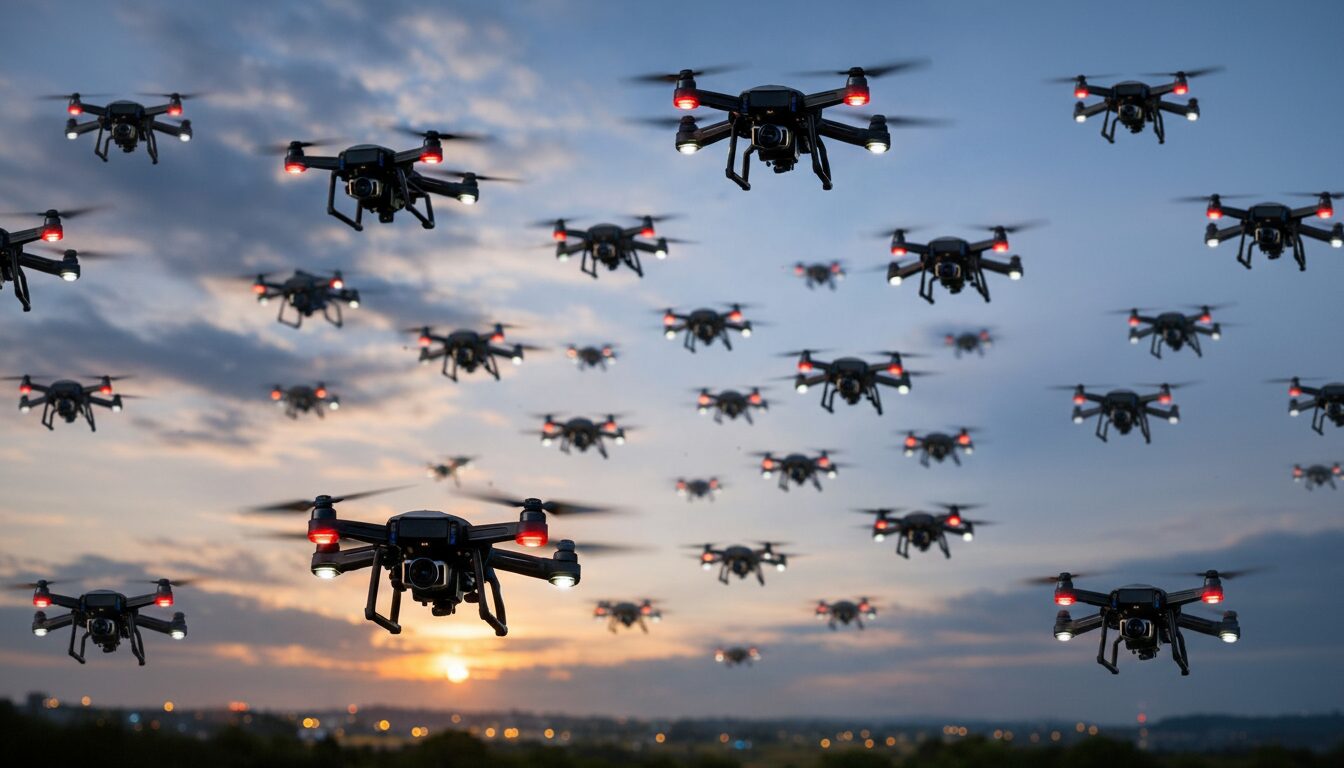
The Technical Backbone of Drone Swarms. In the fast-evolving airspace of 2026, a single drone is just a tool, but a drone swarm is an intelligent organism. While the public marvels at light shows and rapid delivery fleets, the true revolution is happening beneath the chassis.
The “magic” that allows hundreds of autonomous units to fly in perfect synchronization without crashing into each other—or a skyscraper—is built on two sophisticated pillars: Edge Computing and Mesh Networking.
As we move through 2026, the transition from centralized control to Distributed Intelligence has officially reached its tipping point. Here is an in-depth look at the technical backbone making the massive swarms of this year possible.
1. The Shift: From the Cloud to the Edge
In the early 2020s, drones were “dumb terminals.” They captured data and sent it to a central server (the Cloud) for processing. In a swarm of 50 drones, this created a massive “bottleneck”—if the connection lagged for even a millisecond, the drones risked mid-air collisions.
Edge Computing 2026 has solved this by moving the “brain” onto the drone itself. Each unit in a 2026 swarm is equipped with high-performance NPU (Neural Processing Unit) chips.
- Real-Time Obstacle Avoidance: Drones now process LiDAR and computer vision data locally. They don’t ask a server if they should move left; the onboard AI decides in micro-seconds.
- Bandwidth Efficiency: Instead of streaming 4K video back to a base station, a drone identifies a “crack in a pipeline” at the edge and only sends a 10KB alert. This reduces network strain by over 90%.
2. Mesh Networking: The “Conversational” Airspace
If Edge Computing is the brain, Mesh Networking is the nervous system. In 2026, drones no longer rely solely on a single Ground Control Station (GCS). Instead, they talk to each other.
In a Dynamic Mesh Network, every drone acts as a router and a relay.
- Self-Healing Connectivity: If “Drone A” flies behind a concrete building and loses its signal to the pilot, it automatically routes its data through “Drone B” and “Drone C.” The swarm maintains a “bubble” of connectivity that moves with it.
- Lower Latency: Peer-to-peer (P2P) communication in 2026 operates on ultra-wideband (UWB) and specialized 5G-Sidelink frequencies. This allows drones to “whisper” their position to their neighbors at speeds that make human intervention look glacial.
.jpeg)
3. Swarm Intelligence: The “Ant Colony” Logic
The software layer of 2026 is governed by Swarm Intelligence (SI). This is inspired by biological systems like schools of fish or honeybee colonies. There is no “master” drone; rather, each unit follows three simple rules:
- Separation: Don’t get too close to your neighbor.
- Alignment: Move in the same general direction as the group.
- Cohesion: Don’t stray too far from the center of the mass.
By following these local rules, a global behavior emerges. In 2026, this logic allows a swarm to “flow” around an obstacle like water around a stone, then reform on the other side seamlessly.
4. Cyber-Physical Security: The 2026 Standard
As swarms become critical for industrial and military use, they have become prime targets for “Swarm-Jacking” (hacking the collective). The technical backbone of 2026 includes Blockchain-Verified Telemetry.
Each instruction sent within the mesh network is digitally signed. If a rogue signal tries to “spoof” a command to the swarm, the decentralized nodes run a Consensus Check. If 99 drones see the command as invalid, they ignore the 100th “hacked” drone or isolate it from the mesh. This “Immune System” approach makes 2026 swarms significantly more resilient than previous generations.
5. Power Management and “Swarm Relays”
The biggest limitation of drone technology has always been battery life. In 2026, the mesh network is used to solve the energy crisis through Autonomous Rotation.
When a drone’s battery hits 15%, the mesh network triggers a “Relay Event.” A fresh drone from a mobile charging pad takes off and integrates into the swarm’s coordinate system. Once the replacement is in position, the low-battery drone exits the mesh and returns to base. This ensures 24/7 Persistent Surveillance or inspection without the swarm ever having to land.
6. The Role of 6G-Ready Hardware
While 5G is the current standard in early 2026, we are seeing the first 6G-ready hardware appearing in high-end industrial swarms. These systems utilize Sub-Terahertz frequencies, which allow for “Localization-as-a-Service.” Essentially, the drones can sense their position relative to each other with millimeter precision without even using GPS. This is crucial for “GPS-Denied” environments like underground mines or inside nuclear reactors.
Conclusion: The Infrastructure of the Invisible
The technical backbone of Edge and Mesh 2026 has moved drones from being toys to being the most sophisticated distributed computing platform on the planet. By empowering individual units with “Edge” brains and connecting them with a “Mesh” nervous system, we have unlocked a level of efficiency that was science fiction just five years ago.
In 2026, the sky isn’t just full of drones; it’s full of data, decisions, and a collective intelligence that is reshaping our world.
About the Author


